

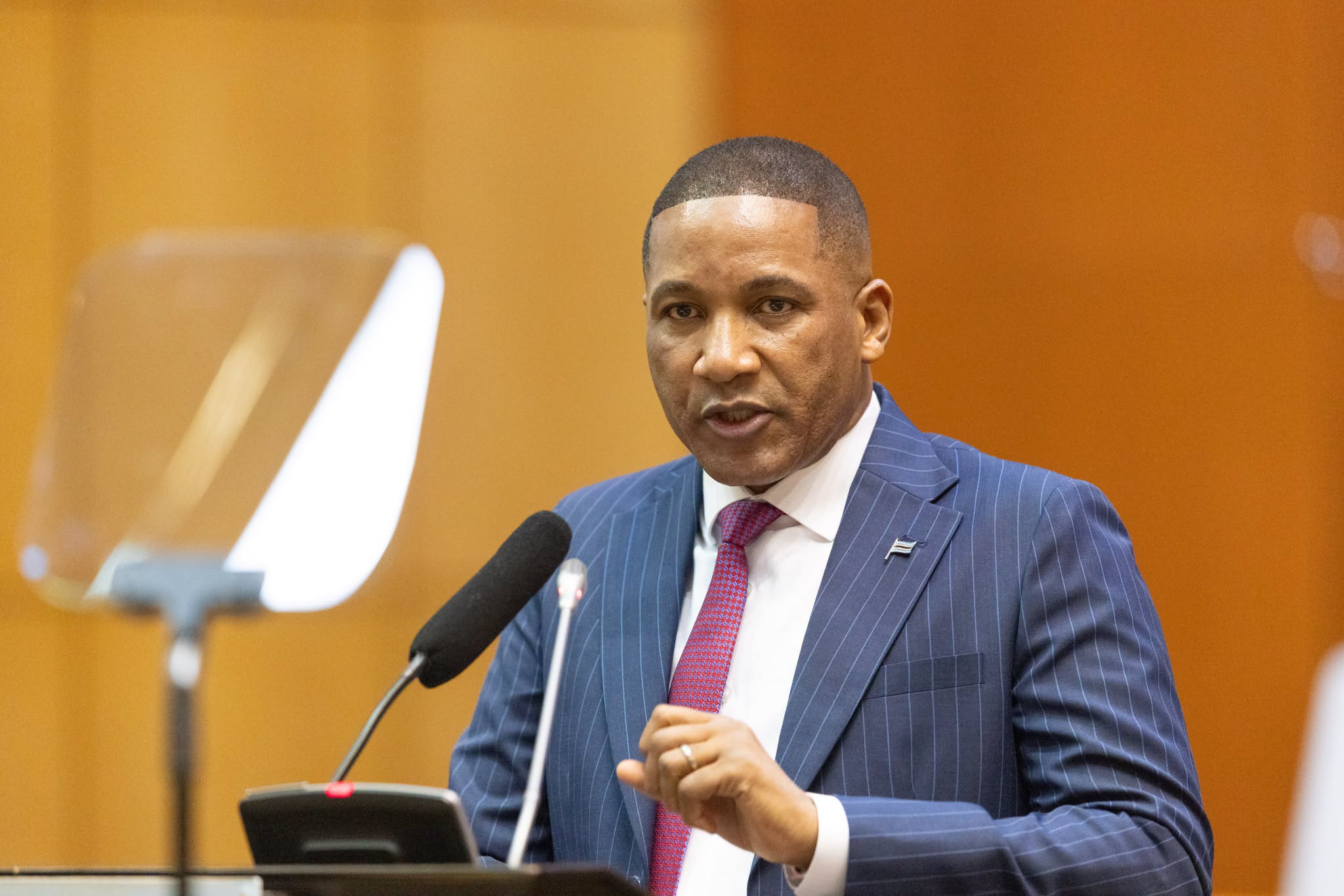
President annouces a historic diamond ownership deal, P33 billion forensic audit findings, major infrastructure investments and sweeping reforms in 2026 State of the Nation Address.
From the National Assembly this afternoon, President Advocate Duma Gideon Boko has announced that Botswana is set to double its shareholding in De Beers from 15 percent to 30 percent, positioning the country as the single largest shareholder in the global diamond company in a landmark development expected to reshape its participation in the international diamond industry.
The announcement was the highlight of Boko’s 2026 State of the Nation Address (SONA), delivered before Parliament in Gaborone on Monday, November 9, under the theme, “The Steady Path Continues: Unleashing the Potential of Our Economy for the Continued Upliftment of All Our People.”
Government has selected the Global Diamond Consortium as its preferred bidder for Anglo American’s 85 percent interest in De Beers. The transaction, once completed, will increase Botswana’s stake to 30 percent, giving the country greater influence over the company’s strategic direction and future decisions.
Boko said the decision followed extensive financial, legal, technical and commercial assessments, guided by principles of sustainable profitability, strategic influence, local beneficiation, financial prudence and responsible risk-sharing.
He further revealed that Angola and Namibia would participate alongside Botswana in the transaction, creating an unprecedented regional partnership among major diamond-producing nations.
The President also highlighted the technological potential of De Beers through its subsidiary Element Six, a global leader in synthetic diamond technology, arguing that Botswana’s investment extends beyond natural diamonds into emerging high-technology industries.
Economic diversification takes centre stage
Beyond the De Beers announcement, Boko used his address to outline Government’s determination to move Botswana away from excessive dependence on diamonds towards a diversified, export-led and digitally enabled high-income economy.
He acknowledged that global conflicts, trade tensions and declining diamond demand had placed considerable pressure on the economy, contributing to rising living costs and unemployment.
However, he maintained that Botswana was beginning to demonstrate economic resilience, with the contraction narrowing from 2.8 percent in 2024 to 0.7 percent in 2025.
Foreign exchange reserves increased by 32.2 percent to P63.2 billion in July 2026, equivalent to 8.3 months of import cover. Meanwhile, Moody’s revised Botswana’s economic outlook from negative to stable in September, although the country’s long-term issuer rating was downgraded from Baa1 to Baa2.
Government also temporarily suspended fuel, road and security-of-supply levies for six months at an estimated cost of P700 million to cushion households and businesses against international price pressures.
A major pillar of the diversification agenda is the Diamonds for Development (D4D) Fund, established through Botswana’s partnership with De Beers. The fund has received its initial annual payment of P1 billion towards the company’s P10 billion contribution.
P33 billion losses uncovered in forensic audit
In one of the address’s most significant governance revelations, Boko disclosed that the National Forensic Audit Programme had identified suspected corruption, fraud, embezzlement, waste and financial mismanagement estimated to have cost the country P33 billion.
The independent audit, undertaken by Alvarez & Marsal, examined 30 public institutions covering the period between 2014 and 2024.
Government has adopted the audit’s recommendations and commenced a reform programme expected to run over the next two to three years. A Special Investigations and Asset Recovery Task Force will be established, alongside strengthened capacity within the Directorate of Public Prosecutions.
Boko said Government was committed to recovering public assets wherever possible and ensuring that individuals found responsible were held accountable.
Institutional reforms will also include strengthening public confidence in governance structures, with Professor Lekoko Kenosi appointed Director General of the Directorate of Intelligence and Security, while Batlhalefi Josti Moeletsi assumed leadership of the Directorate on Corruption and Economic Crime.
Infrastructure and energy investment
Infrastructure development featured prominently, with Government accelerating major projects intended to strengthen Botswana’s industrial and logistical capacity.
The 1,600-kilometre Trans-Kalahari Railway Project and the Chobe-Zambezi Water Transfer Scheme are among the strategic developments expected to advance procurement during the 2027/28 financial year following the completion of bankable feasibility studies.
The P25.5 billion New Airport City development, being undertaken through a partnership involving the Botswana Development Corporation and ALBADDAD Holding, has also commenced construction. The project includes a 124,000-square-metre international exhibition and convention centre.
In the energy sector, Government has added 200 megawatts of solar power to the national grid through the Mmadinare and Jwaneng solar power plants. Electricity imports declined by 62 percent, from 492 gigawatt-hours to 187 gigawatt-hours, reflecting improved domestic generation and the operational performance of Morupule B.
Government has also approved P772.4 million for urgent maintenance of six sections of the A1 highway, while several other road rehabilitation projects are progressing nationwide.
Jobs, education and social protection
On employment, the President reported that the Public Service Insourcing Programme, launched in April 2026, is projected to absorb approximately 9,380 Batswana into better-paying permanent positions. Already, 4,366 eligible temporary employees have been absorbed.
Through the Ikageng Public Works Programme, nearly 27,600 young people have been engaged, 79 percent of whom are women. Government has spent more than P820 million on labour since 2025, with over P274 million paid directly to programme participants.
The Bonno National Housing Programme has also moved into implementation, with 567 previously initiated housing units completed and handed over across several locations. Construction of 1,366 additional units has commenced.
In education, Government increased tertiary student allowances from P1,900 to P2,200, while TVET allowances were raised from P300 to P2,200. The President reiterated Government’s ambition to fulfil its commitment to a P2,500 student allowance.
The newly introduced Child Support Grant has benefited 16,501 infants, with P34.3 million disbursed between July and October 2026.
Government is also advancing universal healthcare through the National Health Insurance Policy, approved by Parliament in August, with the necessary legislation now being developed.
Agriculture, tourism and new investment opportunities
Boko highlighted agriculture as another critical pillar of diversification, reporting that the Lemang Dijo programme distributed 74,846 vouchers worth P191 million during the last farming season.
However, the foot-and-mouth disease outbreak significantly affected the beef industry, reducing abattoir offtake to 4,725 tonnes against a target of 70,000 tonnes. Government deployed P97 million in emergency funding to contain the outbreak and restore the country’s disease-free status.
In dairy production, 600 Girolando cows had been imported for Milk Valley Farm in Lobatse, with the operation targeting approximately 15 million litres of milk annually at full capacity.
Tourism diversification will also receive attention through the Dams Tourism Initiative, while 29 sites at Shashe, Thune and Letsibogo dams are expected to be awarded during 2027.
In mining, Botswana was ranked first in Africa and seventh globally in the Fraser Institute’s Investment Attractiveness Index, reinforcing its position as an investment destination.
The industrial hemp sector has also attracted 14 major project proposals, with four provisional licences representing P290 million in proposed investment.
A new chapter in Botswana’s development
Boko concluded by reaffirming his Government’s commitment to building an economy in which every Motswana is employed, empowered and fulfilled.
He acknowledged the country’s economic difficulties but maintained that sustainable transformation would require a shift from debating the distribution of limited resources towards expanding production, strengthening infrastructure and creating new economic opportunities.
The 2026 address therefore placed significant emphasis on translating policy commitments into measurable economic outcomes, with the proposed increase in Botswana’s De Beers shareholding emerging as a defining milestone in the country’s efforts to secure greater value from its natural resources.
As Government pursues its diversification agenda, the challenge will be ensuring that these investments, reforms and partnerships translate into sustainable employment, improved public services and tangible improvements in the livelihoods of Batswana.
